We live in an absolutely exciting universe.
The Hudson School Science Department inspires curiosity through hands-on laboratory experiences in physics, chemistry, and biology — building students into informed, critical thinkers who understand the difference between scientific fact and unsupported belief.
Science that connects the classroom to the world.
Science courses at The Hudson School are grounded in the belief that all students can succeed in science as long as they work hard and develop sound study methods. We train students to appreciate science for its openness, built-in self-criticism, problem-solving power, and flexibility to embrace change when facts dictate. Students learn to recognize the difference between factual scientific thought and unsupported belief — a vital skill for informed global citizens. The required sequence is Physics (Grade 9), Chemistry (Grade 10), and Biology (Grade 11).
{{BAND_LINK_LABEL}}
Three required sciences. AP options. Specialized electives.
-
Physics (Grade 9) & Chemistry (Grade 10)
Physics covers kinematics, dynamics, fluid mechanics, thermal physics, waves, optics, and electromagnetism — with a lab component and professionally typeset reports using LATEX. Chemistry addresses nomenclature, stoichiometry, bonding, gas laws, reaction types, and organic chemistry.
-
Biology (Grade 11) & AP Sciences
Biology is a full-year in-depth study of biochemistry, cell biology, genetics, evolution, ecology, and human anatomy. AP Biology, AP Chemistry, and AP Physics (Mechanics and Electromagnetism, calculus-based) are available with department approval.
-
Human Anatomy & Neuroscience
Specialized electives include Human Anatomy & Physiology — exploring body systems, homeostasis, and disease — and an interdisciplinary Neuroscience seminar connecting biology, psychology, and cognitive science from the molecular to the behavioral level.
-
Engineering & Robotics
Engineering/Robotics I and II walk students through the full design process — identifying problems, prototyping, programming, and refining — using electronics, CAD, and sensors to build real autonomous machines. Also counts toward Computer Science requirements.
Professional laboratory practice from day one.
All science courses include substantial laboratory components. Students gain hands-on experience with modern equipment and conduct rigorous scientific investigations — with reports professionally typeset using LATEX templates, the same standard required by academic journals. Many experiments use computer-based data collection systems, giving students experience with the technology used in contemporary research and bridging the gap between classroom learning and real-world scientific practice.
{{BAND_LINK_LABEL}}
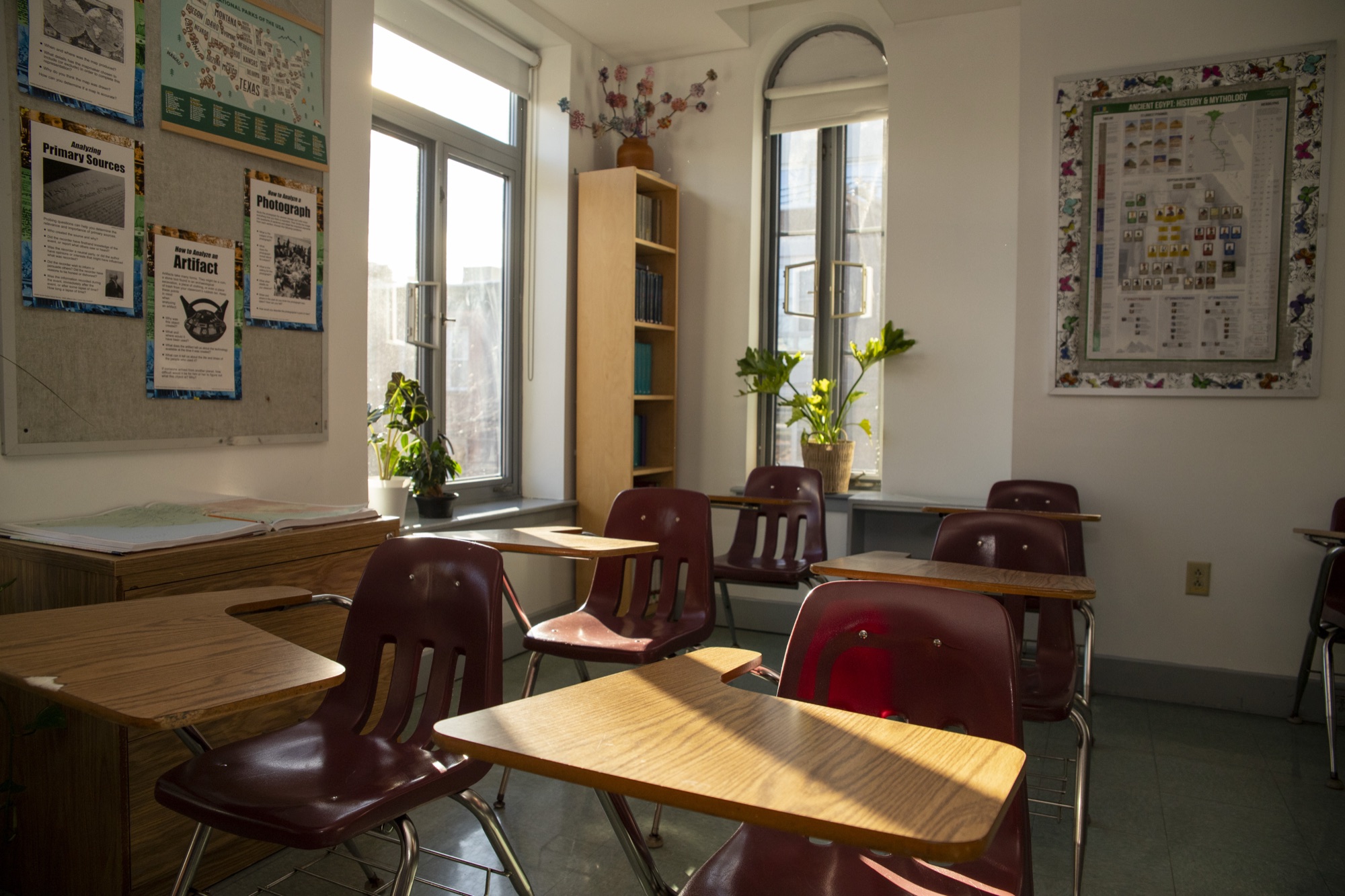
Curious about what our labs look like?
Come visit The Hudson School’s Upper School campus on Park Avenue and see where our scientists ask the questions that matter.
Schedule a Visit